For providers in the FCC's Robocall Mitigation Database
Check your RMD filing before you recertify it.
Between February 1 and March 1, an officer at your company certifies that everything in your filing is still accurate, including your robocall mitigation plan. Our free check reads your public filing and plan next to the FCC's guidance and emails you what's worth a second look.
Quiet Deadline is independent and not affiliated with the FCC. You can make both March 1 filings directly with the FCC at no charge, and we show you how below.
What the check finds in real filings
We ran our check on 97 randomly chosen public filings on October 31, 2026. Most had something worth confirming before an officer certifies it again.
Why accuracy matters more this year
Since February 5, 2026, the FCC's base fine is $10,000 for each violation when a filer submits false or inaccurate information to the database, and $1,000 for not updating changed information within 10 business days (FCC 24‑135). Recertifying is your officer's statement that everything on file is still accurate, so it's the natural moment to look.
An item is something to confirm, not a finding that a company breaks the rules. The check describes what a filing says next to the FCC's published guidance; it isn't legal advice.
What the free check sends you
Enter your RMD number, or your company's FRN, and the email address for the results. We pull your filing and mitigation plan from the FCC's public database, read them the same way our paid report does, and email you a numbered list: each item, with one line on what to do about it.
If nothing stands out, we say so. Either way, the check is yours to keep, and you can act on it yourself.
Here's what we found when we read Kestrel Voice Networks' public Robocall Mitigation Database filing and its robocall mitigation plan next to the FCC's guidance.
2 items worth checking before you recertify:
- Call analytics in your plan
Name your call analytics system or vendor in your plan; it currently describes analytics only in general terms. - Your STIR/SHAKEN option
Check that your plan explains your partial implementation without relying on an expired extension.
Two filings, one deadline
Providers in the FCC's Robocall Mitigation Database recertify their filings every year by March 1. Telecom carriers and interconnected VoIP providers also file their annual CPNI certification the same day.
Robocall Mitigation Database recertification
Someone logs in to the FCC's database and confirms that everything in your filing is still accurate, including your STIR/SHAKEN certification and your robocall mitigation plan, and an officer e-signs. Updating your filing during the year doesn't count. Recertifying is a separate step that only appears during the February window.
- Who files
- Every provider whose filing existed before this year
- Where
- The FCC's database, from your own FCC login
- FCC fee
- None in effect (FCC FAQ, July 9, 2026)
- Why it matters
- A base fine of $10,000 per violation for false or inaccurate information (FCC 24‑135), and other providers must stop accepting calls directly from any company the FCC removes from the database
- Rule
- 47 CFR § 64.6305(h)
Annual CPNI certification
An officer certifies that the company's procedures protect its customers' private network information, such as call records and account details, and attaches a statement explaining how. The 2027 filing covers calendar year 2026.
- Who files
- Telecom carriers and interconnected VoIP providers, with no small-company exemption
- Where
- EB Docket 06-36, through the FCC's ECFS or its CPNI web app
- FCC fee
- None
- Why it matters
- The FCC can fine companies for each violation of its CPNI rules (Enforcement Advisory DA 26‑139)
- Rule
- 47 CFR § 64.2009(e)
When you'd rather have it done
One payment, documents in your inbox usually within minutes, and no subscription.
RMD Recertification Report
$149per filing
Everything in the free check, explained, plus all you need to recertify.
- Each item from your check with the FCC guidance behind it and the exact words from your plan
- Every field in your public filing, what's on file now, and what to confirm
- A checklist for your mitigation plan, matched to your role in the call chain
- Recertification steps button by button, and what to do if the Recertify button doesn't appear
- What the FCC has proposed for the database, and your deadlines for the rest of the year
- Delivery
- PDF by email, usually within minutes
- You provide
- Your RMD number or FRN at checkout
CPNI Certification
$199per company
Your annual CPNI certification, drafted for your officer and filed for you.
- Drafted from a 10-minute questionnaire, on the FCC's own template
- An accompanying statement that describes only what you told us you do
- A check against the problems the FCC most often finds, before your officer signs
- We file your signed certification in ECFS and send you the FCC's confirmation
- Delivery
- Questionnaire link right away; certification usually within minutes of your answers
- You provide
- Your RMD number at checkout, then the questionnaire
March 1 Bundle
$299per company
Both March 1 filings prepared together, for $49 less than buying each.
- Everything in the RMD Recertification Report
- Everything in the CPNI Certification
- One order and one questionnaire for both filings
- Your report arrives first, so you can start on the RMD while you answer the questionnaire
- Delivery
- Report usually within minutes; certification usually within minutes of your questionnaire
- You provide
- Your RMD number at checkout, then the questionnaire
What we don't do
- Recertify for you. It has to be done from your own FCC login.
- Write your robocall mitigation plan. Your officer certifies it, so it should describe what you actually do.
- Give legal advice or decide whether your company complies. For that, talk to telecom counsel.
Refunds and multiple filings
If your documents don't save you time, email us within 30 days of purchase for a full refund.
Have several RMD filings? Each purchase covers one filing, so check out once for each RMD number.
You can file both yourself, at no cost
Plenty of companies do. The FCC publishes everything you need, and these are the same documents we work from. We're for teams who would rather spend twenty minutes than an afternoon.
- Robocall Mitigation Database portalWhere you log in to recertify
- RMD filing instructionsThe FCC's step-by-step guide with screenshots
- RMD questions for filersThe FCC's FAQ, last updated July 9, 2026
- CPNI Enforcement Advisory DA 26‑139Includes the FCC's certification template
- ECFS standard filingWhere CPNI certifications are filed, in docket 06-36
How it works
-
Run the free check
Enter your RMD number and email. Within a few minutes you have a list of what's worth a second look in your filing.
-
Order what you need
The report explains each item and walks you through recertifying. The CPNI certification is drafted from your questionnaire answers.
-
You sign and file
Recertify from your own FCC login between February 1 and March 1. Send us your signed CPNI certification and we'll file it.
See exactly what you get
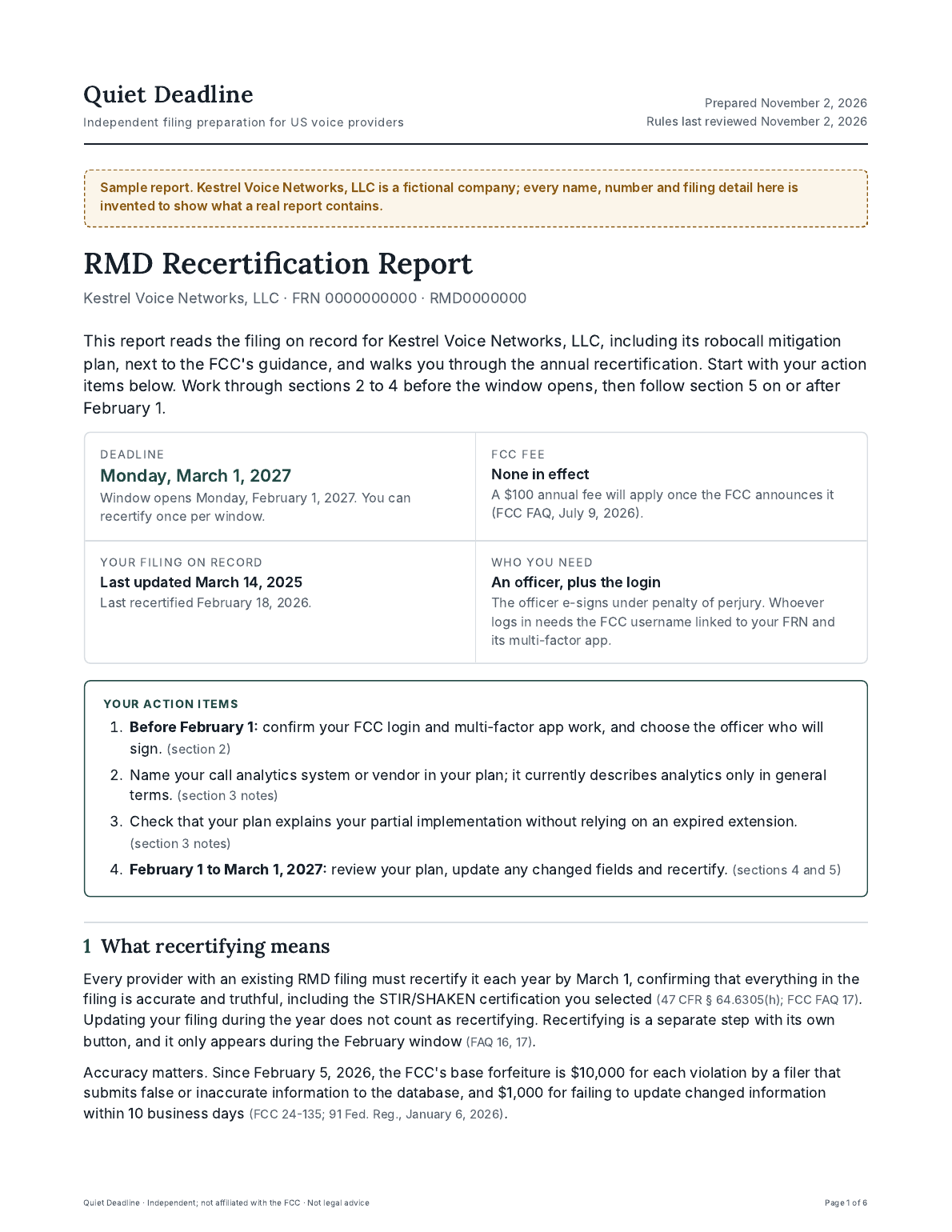
These samples were prepared for Kestrel Voice Networks, a fictional company, using the same process as a real order.
RMD Recertification Report
Action items, the filing field by field, a plan checklist and the recertification steps.
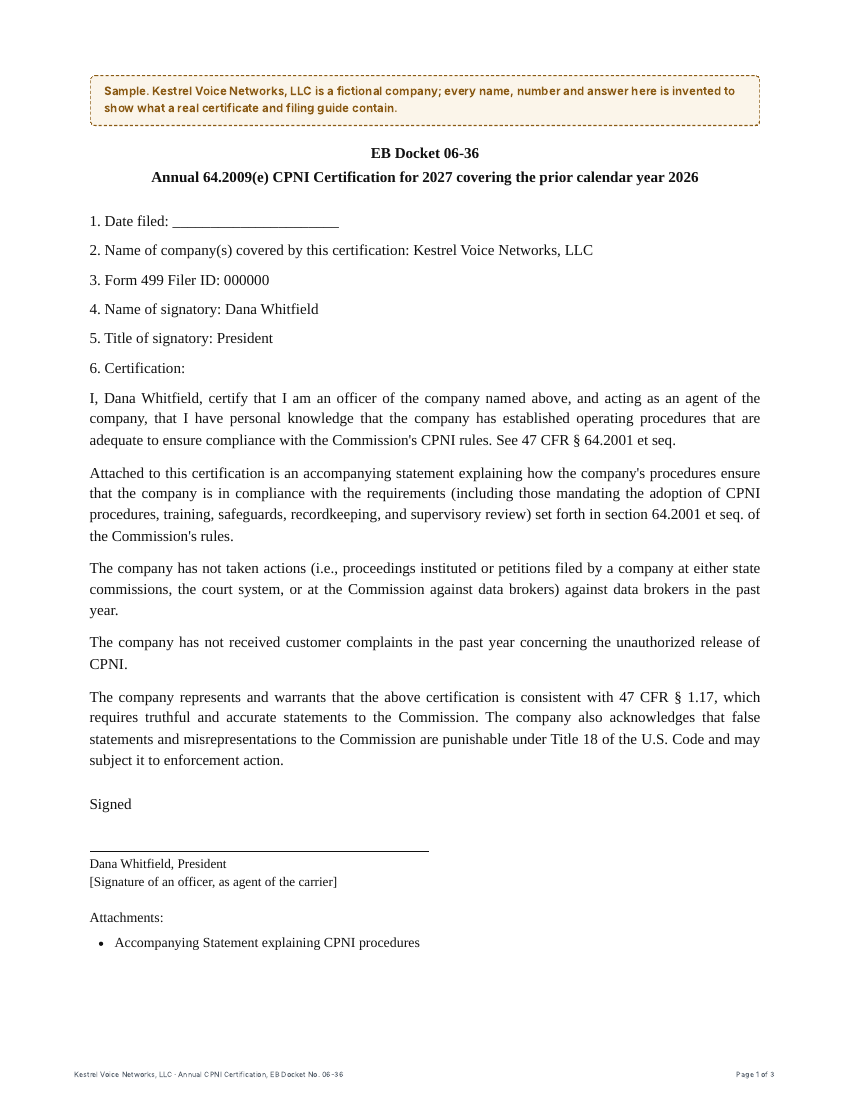
CPNI certification
The certificate on the FCC's template with its accompanying statement, ready for signature.
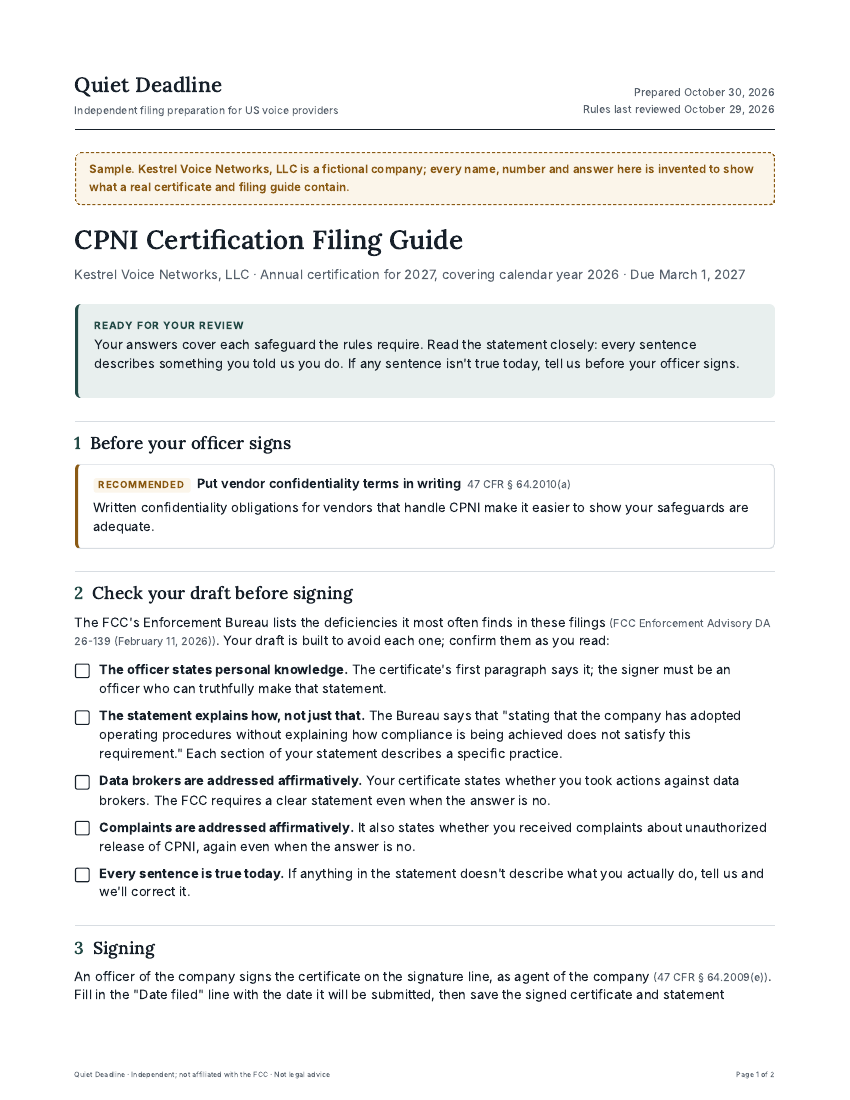
CPNI filing guide
Anything to fix before signing, a check of the draft, and how the filing gets made.
Kestrel Voice Networks and every name and number in these samples are invented. Your documents are built from your company's real public filing.
Who we are
Quiet Deadline is an independent business in New York that prepares filing documents for small U.S. voice providers. We are not affiliated with the FCC or any government agency, and we never charge or collect government fees.
Our documents are preparation guidance, not legal advice. When a question needs a judgment about your company's compliance, we say so and point you to telecom counsel.
Questions go straight to Tyler at tyler@quietdeadline.com.
Sources
Rules last reviewed November 2, 2026
We recheck every source before each filing season and before every report, and update the documents and this page if anything changes.
- 47 CFR § 64.6305Robocall mitigation and annual recertification
- FCC Robocall Mitigation Database FAQ for filersLast updated July 9, 2026
- FCC Robocall Mitigation Database filing instructionsJuly 2026 version
- FCC 24‑135, Robocall Mitigation Database orderFines for inaccurate filings; effective February 5, 2026
- FCC 26‑49, proposed changes to the databaseProposals only; published September 9, 2026
- 47 CFR § 64.2009CPNI safeguards and annual certification
- FCC Enforcement Advisory DA 26‑139February 11, 2026
Questions
Are you the FCC, or working with them?
No. Quiet Deadline is an independent business with no connection to the FCC or any government agency. We prepare documents that help you complete filings the FCC requires, and you can always file directly with the FCC instead.
Why did we get an email from you?
Your company's Robocall Mitigation Database filing is public on the FCC's website, and it lists you as the robocall mitigation contact. We email that contact about the March 1 filings. Every email has an unsubscribe link, and once you use it we won't email you again.
Is the free check really free?
Yes. There's no payment step and nothing to sign up for. We email your results, and before March 1 we may send one or two reminders about the filings; each has an unsubscribe link. If you order the report afterwards, it explains each item your check found in detail.
Is the FCC changing the rules?
Two things are worth knowing as of November 2, 2026. First, rules in effect since February 5, 2026 set a base fine of $10,000 per violation for false or inaccurate information in the database, and $1,000 for not updating a filing within 10 business days of a change (FCC 24‑135).
Second, in July 2026 the FCC proposed more changes (FCC 26‑49): new certifications in every filing, mitigation plans that cover all illegal calls rather than only robocalls, more detail on STIR/SHAKEN exemptions, and faster removal of filers that don't comply. These are proposals only, and they haven't been adopted. If the FCC adopts them before March 1, we'll update this page and every report we prepare.
Do you file for us?
For the CPNI certification, yes. With the CPNI Certification or the March 1 Bundle, we submit your signed certification in ECFS and send you the confirmation. The RMD recertification has to be done from your own FCC login with your officer's e-signature, so the report walks you through it instead.
How do you know what's in our filing?
Robocall Mitigation Database filings are public, including the mitigation plan. Your check and your report are built from what the database shows for your company on the day we prepare them, and they list the date we viewed it.
Is there an FCC fee?
Neither filing has an FCC fee in effect. The FCC has said a $100 annual fee for the Robocall Mitigation Database will apply once it announces the fee, and as of its July 9, 2026 FAQ it hadn't. We never charge or collect government fees.
What if something in our filing looks wrong?
Your check lists anything worth a second look, and your report explains each item and quotes the FCC guidance behind it. Both describe what your filing says; they don't decide whether you comply. For that kind of question, we recommend telecom counsel.
We have more than one filing.
Each RMD filing gets its own report, so check out once for each RMD number. The FCC wants a separate CPNI certification for each affiliate with its own Form 499 Filer ID, so the same goes for CPNI certifications and bundles: one purchase per company.
When do we get our documents?
By email, usually within a few minutes of your order and always within one business day. CPNI certifications arrive the same way after you send your questionnaire.
What's your refund policy?
If your documents don't save you time, email us within 30 days of purchase and we'll refund you in full.